
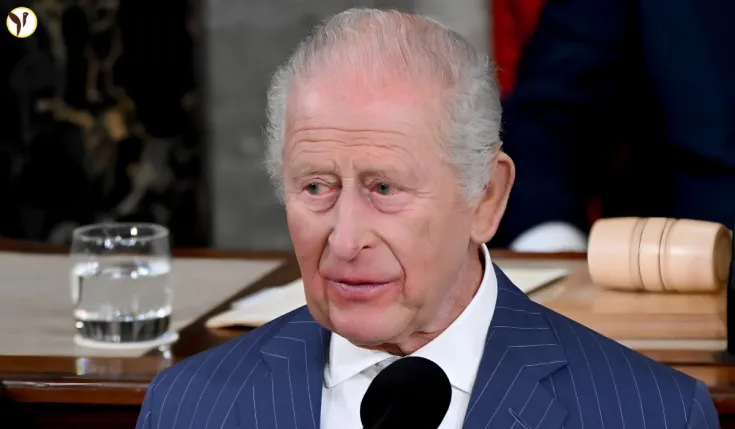

A reigning British monarch walked into the U.S. House Chamber on Tuesday afternoon and did something no king before him had ever done: he addressed a joint session of the United States Congress. King Charles III delivered his speech to Congress on April 28, during his first official state visit to the U.S. since becoming Britain's reigning monarch in 2022.
What followed was not the polite, ceremonial address many expected. It was pointed, politically charged, and at moments — astonishing. Here are the five takeaways that will be talked about long after the red carpets are rolled up.
5 Shocking Takeaways from King Charles
1. A King Lecturing America on Checks and Balances — and Getting a Standing Ovation
This was the moment that stopped Washington in its tracks.
Charles pointed out that the ideals of America's founding were rooted in the tradition of English law, including the principle that executive power is subject to checks and balances — a concept tracing back to the Magna Carta of 1215. He noted that the Magna Carta has been cited in at least 160 Supreme Court cases since 1789.
The king received a standing ovation from Democrats and Republicans alike when he invoked this principle. The timing was electric. The king's remarks came during a term when critics argue Trump has expanded executive power — deploying military and law enforcement in U.S. cities, and using investigations to target political opponents.
Charles never named Trump. He didn't need to.
2. He Broke With Trump Directly on Ukraine — From the House Floor
This wasn't subtext. It was a clear, public divergence from the sitting U.S. president.
Charles called for the same unyielding resolve that NATO allies showed after 9/11 to now be applied to the defense of Ukraine, addressing Speaker Mike Johnson directly from the floor. Since Trump returned to office, he and Republican leaders have shown increasing frustration with the cost of supporting Ukraine's defense.
When the king called for peace in Ukraine, the chamber again broke into bipartisan applause — despite significant fractures within the legislative branch over continued assistance there.
3. He Defended NATO — Dismantling Trump's Talking Point in Real Time
Trump has repeatedly argued that U.S. allies fail to carry their fair share of the defense burden. King Charles addressed this directly.
Charles announced that the United Kingdom has committed to its biggest sustained increase in defense spending since the Cold War, noting his own personal service in the Royal Navy.
He was unequivocal in rejecting the claim that NATO allies never make sacrifices, reminding Congress that when Article 5 was invoked for the first time after 9/11, allies answered the call — through two World Wars, the Cold War, and Afghanistan.
The king stressed that the mutual defense, intelligence, and security ties between the U.S. and UK are hardwired together through relationships measured not in years, but in decades.
4. A Coded Plea on Climate Change — Aimed Squarely at Trump's Rollbacks
Charles — who boasts a decades-long commitment to environmentalism — gave a veiled plea for protecting the natural environment and ecosystems, saying "our generation must decide how to address the collapse of critical natural systems."
This came as a coded call for tackling climate change, which President Trump has called a "con job" — and following his withdrawal of the U.S. from the Paris Climate Agreement and repeal of multiple environmental regulations.
The word "climate" never appeared. The message was unmistakable.
5. He United a Divided Congress — Something Almost Nobody Else Has Managed
Perhaps the most stunning moment wasn't political at all. It was simply the atmosphere in the room.
In stark contrast to the last State of the Union — marked by empty seats, walkouts, and disruptions — the House Chamber was packed, filled with laughter, unity, and bipartisan standing ovations.
Trump, watching from elsewhere as protocol required, said afterward that he "couldn't believe" the king's remarks prompted Democrats to stand and applaud, calling it "a great speech" and adding, "I was very jealous."
Buckingham Palace said the king was "deeply honoured" to have been invited as the first British king to give such an address, and "greatly touched by the warmth and generosity of the response."
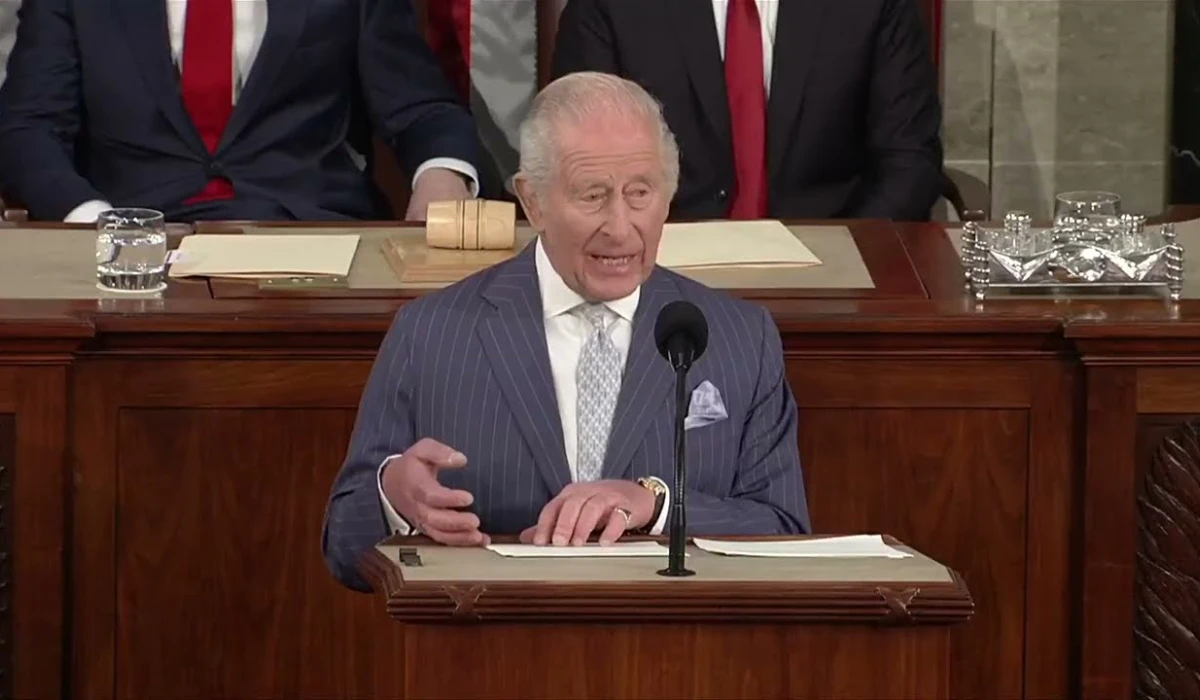
The Bigger Picture: What This Speech Really Meant
|
|
|
|
|
|
|
|
|
|
|
|
|
|
|
|
|
|
|
|
|
|
|
|
Read the full transcript of King Charles’ U.S. Congress address https://t.co/j1PnWQtSkQ
— The Globe and Mail (@globeandmail) April 29, 2026
What Happens Next
King Charles and Queen Camilla will travel to New York City for the third day of their U.S. visit, where they will pay their respects to 9/11 victims ahead of the attack's 25th anniversary in September.
Before the state dinner, Charles met with some of America's most powerful tech leaders — including Jeff Bezos, Jensen Huang, Tim Cook, and Ruth Porat — discussing AI guardrails and startup funding.
The diplomatic optics of this visit will echo for months. Charles navigated an extraordinarily delicate tightrope — honoring the U.S.-UK alliance while implicitly pushing back on policies that London finds troubling. He did it without breaking diplomatic protocol, without uttering a single direct criticism, and without losing the room.


